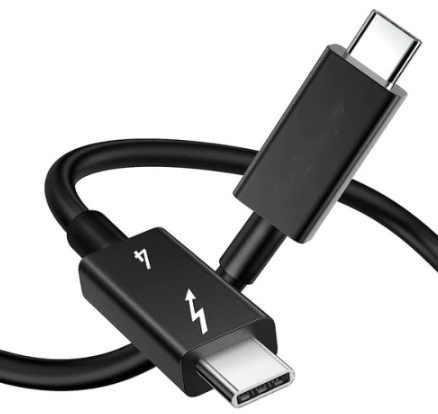
Docking rarely lands on the strategic agenda — until the wrong standard ships across a few hundred desks and the cost surfaces in helpdesk tickets instead of the purchase order. USB4 has changed enough about how docks behave that it's worth a deliberate look before the next refresh cycle locks a choice in for three to five years.
The usual sequence is to evaluate the laptop on performance, security, and cost, then pick a dock from an approved vendor list and sign off on price. That works while the dock market sits still. It isn't sitting still right now: new Apple Silicon Macs and current-generation Windows laptops ship with USB4 natively, and that shifts the calculus on drivers, helpdesk load, and what a docking standard actually needs to do. Teams that tie the docking decision to refresh planning tend to standardize faster and with fewer surprises. This guide covers what USB4 is, what it changes operationally, how to think about cost, and the questions worth asking any vendor before the spec is final.
What Is USB4?
USB4 is the current generation of the USB standard. It runs over USB-C connectors, carries several protocols over one link at the same time, and delivers up to 40 Gbps of bandwidth in its widely deployed form — enough to cover most enterprise docking workloads that previously called for Thunderbolt 4. (The newer USB4 Version 2.0 raises the ceiling to 80 Gbps on hardware that supports it; most fleet docks today are still built around the 40 Gbps generation.)
Bandwidth, and what it means inside a dock
A docking station divides its available bandwidth across everything connected at once — two displays, a wired LAN link, USB peripherals, and charging all draw from the same pool. At 40 Gbps (USB4 Gen 3x2), a dock has enough headroom to drive dual 4K displays at 60 Hz while also moving file transfers and network traffic. At 20 Gbps (USB4 Gen 2x2), dual-4K output becomes bandwidth-constrained depending on refresh rate and color depth. The practical takeaway: confirm which USB4 generation the dock's silicon actually implements, because the figure printed on the box is not always the figure on the chip.
Protocol tunneling: why one cable does the work of several
USB4's defining feature is protocol tunneling. A single connection carries DisplayPort for video natively (no conversion layer), PCIe for storage and peripheral bandwidth, and USB 3.2 for ordinary USB devices — concurrently. For teams managing desk standards across hundreds or thousands of seats, the single-cable model cuts installation variables and reduces the number of things that can go wrong at the desk.
Backward compatibility
USB4 runs over USB-C and is backward compatible with USB 3.2 and USB 2.0, and — on supported devices — with Thunderbolt 3 and Thunderbolt 4. A USB4 dock connected to an older laptop's USB-C port still works; bandwidth is capped at the host port's native speed, not the dock's maximum. That matters for mixed-fleet transitions: introducing USB4 docks across a fleet that still includes older USB-C devices doesn't require a full hardware refresh first.
How USB4 relates to Thunderbolt
Comparison: USB4 vs. Thunderbolt 4 vs. DisplayLink vs. USB 3.2
| Feature | USB4 Gen 3x2 | USB4 Gen 2x2 | Thunderbolt 4 | DisplayLink | USB 3.2 Gen 2 |
| Max bandwidth | 40 Gbps | 20 Gbps | 40 Gbps | Variable (software-compressed) | 10 Gbps |
| Dual-display | Native, driverless | Bandwidth-dependent | Native, driverless | Driver-dependent | On hosts supporting DP Alt Mode |
| Driver required | No | No | No | Yes — OS-level driver on Windows and macOS | No (on compatible hosts) |
| Native to current Macs / Windows | Yes | Yes | Yes (Intel-based + Apple Silicon Thunderbolt) | No — driver install required | Varies by model |
| Relative cost | $ | $$ | $$$ | $$$ | $$ |
Figures reflect published USB-IF, VESA, and Intel specifications. Relative cost is general market positioning and varies by configuration and region; verify against current vendor datasheets.
A note on DisplayLink: because its second-display output runs through a software compression layer, it can drive displays beyond a host's native limit, but HDCP-protected playback (mainstream streaming services) may stop across displays when a DisplayLink output is active. That's a limitation to disclose to users, not something to design around.

What Changes for IT
The single most operationally significant change in enterprise docking in the past decade is the move away from a per-endpoint driver.
The driverless advantage, in operational terms
A DisplayLink docking solution needs a software driver on every endpoint — deployed, versioned, updated, and monitored like any managed application. In practice that means driver packages tested against each new OS release before rollout, a documented support category for conflicts with GPU software, conferencing apps, and security agents, and validation work every time a new device model enters the fleet. A USB4 dock using native DisplayPort tunneling handles display output at the hardware protocol level — there's no software layer to manage. For a team running several hundred seats, that difference doesn't appear on a spec sheet; it appears in ticket volume, image-deployment time, and staff hours per refresh.
What happens to an existing DisplayLink fleet
If your current standard uses DisplayLink, there's no emergency. DisplayLink keeps working on existing hardware; the transition is a planning question, not a fire drill. The practical issue is maintenance: DisplayLink drivers need active upkeep across OS updates, and as macOS and Windows increasingly treat USB4 as the default connectivity path, that software layer introduces friction native USB4 doesn't. Mapping the transition to your next refresh keeps the timeline and rollout sequence on your terms rather than the market's.
Backward compatibility for fleets mid-transition
A USB4 dock connected to an older laptop's USB-C port runs at that host's bandwidth ceiling — typically a single display at full resolution plus USB data and charging. The display upgrade is realized when the host is refreshed to a USB4-capable port. That enables a staged rollout: deploy USB4 docks now, and each device picks up the full benefit as it's refreshed — no second dock purchase and no parallel deployment window.
The Cost Picture
|
Deployment size |
Hardware saving (illustrative) |
Driver-labor saving vs DisplayLink (illustrative) |
3-year total (illustrative) |
|
100 seats |
$7,500 |
$2,250 |
$9,750 |
|
500 seats |
$37,500 |
$11,250 |
$48,750 |
|
1,000 seats |
$75,000 |
$22,500 |
$97,500 |
Hardware saving = per-unit acquisition delta × seats. The labor line applies only against a DisplayLink comparator; a Thunderbolt 4 comparator is already driverless, so only the hardware line applies there. All values are modeled from the assumptions above, not measured — state those assumptions wherever you publish the numbers.
How to Evaluate a USB4 Dock: Five Questions to Ask Any Vendor
The specification on the box covers the standard. It doesn't cover the testing program, the compatibility matrix, or the vendor's ability to support a global rollout. These questions separate a vendor who tested the dock from one who certified a spec sheet.
1. Has this dock been tested against the specific Mac and Windows models in our fleet — or only against a reference device list? A reference list confirms the dock meets the USB4 standard. A tested compatibility matrix confirms it works in the environment you manage. Ask for the matrix, not the marketing line — it matters most on Apple Silicon, where display capability varies by chip.
2. Is dual-display output truly driverless, or does it rely on a software layer for the second display? Some docks drive the primary display over DP Alt Mode and the second through software compression — a hybrid where one display is driverless and one isn't. Confirm the dual-display architecture before assuming driver management is gone.
3. What display output does the dock deliver on a USB-C (non-USB4) host, and does that meet our minimum for the devices currently deployed? For mixed refresh schedules, this decides whether one dock standard can serve old and new devices through the transition. Single-display output on USB-C hosts is a workable constraint — if you plan for it.
4. How has the dock been validated for mixed Windows-and-Mac deployment across varied monitor models? A dock tested on one Dell and one MacBook against two identical monitors is not the same as one validated across varied resolutions and refresh rates. Ask what the program actually covered.
5. When a new device model ships, what's the vendor's process for validating compatibility and communicating the result? New devices arrive on a regular cadence; a dock standard shouldn't need re-evaluation every time a refresh touches a new machine. Ask for the process, not the promise.
PURPLELEC's Approach to USB4 Docking
PURPLELEC is a Shenzhen-based manufacturer with its own factory and 18 years of R&D experience in USB-C connectivity — docking stations, USB hubs, video capture cards, and hard drive enclosures — supplying OEM/ODM programs for global brands. The approach to USB4 docking is a deployment problem first and a specification exercise second.
PURPLELEC validates its docking hardware against standards a buyer can verify independently, rather than self-reported lab counts. The company runs its own factory with 18 years of OEM/ODM production for global brands, and its product range includes Intel-certified Thunderbolt 5 docks and enclosures — hardware that has passed Intel's mandatory certification testing, an independent benchmark of interoperability and signal integrity. For the USB4 docking tier, each unit is verified for compatibility across Windows and macOS hosts and a range of display configurations before it ships, and a verified compatibility list for a given SKU is available to buyers on request.
That combination — a certification record that holds up to outside scrutiny, plus a compatibility list tied to specific models rather than a marketing figure — is what lets an IT or procurement team confirm a dock before deployment instead of discovering edge cases through a helpdesk ticket.
Mac compatibility: the precise picture
Dual-display behavior on Apple Silicon depends on the chip variant, and it's worth auditing before standardizing. This is a hardware characteristic of Apple Silicon, not a dock limitation:
• M1 / M2 (base): one external display only — a hard silicon cap.
• M3 (base): two external displays, but only with the laptop lid closed (clamshell), on macOS Sonoma 14.6 or later.
• M4 / M5 (base): two external displays with the lid open — the clamshell restriction is lifted.
• Pro chips: two external displays. Max chips: up to four. Ultra chips: up to eight.
For fleets running base M1 or M2 MacBooks, a single-display standard (or a lid-closed clamshell policy) is the right starting point, and both are straightforward to document. Always verify the exact figures against Apple's current published tech specs for the specific model, since support has shifted with each chip generation and macOS release.

What 18 years of manufacturing means in practice
The value isn't the heritage claim — it's accumulated knowledge of what actually breaks when a dock that passed lab testing meets a few hundred mixed devices in the field: which combinations fail, what the support calls look like, and where compatibility gaps surface months after deployment. That knowledge is what a validation program and a citable compatibility matrix are meant to capture before the product ships.
The short version for IT and procurement: one dock standard for a mixed Mac-and-Windows fleet — driverless display output, charging delivered to the host, and wired networking over a single cable — validated before deployment rather than discovered through a helpdesk ticket.
Ready to validate USB4 against your fleet?
PURPLELEC's team can run a compatibility review for IT and procurement teams evaluating a docking standard ahead of a refresh: map your device models — Mac and Windows — against the dock's compatibility matrix and surface any edge cases before they become deployment issues.